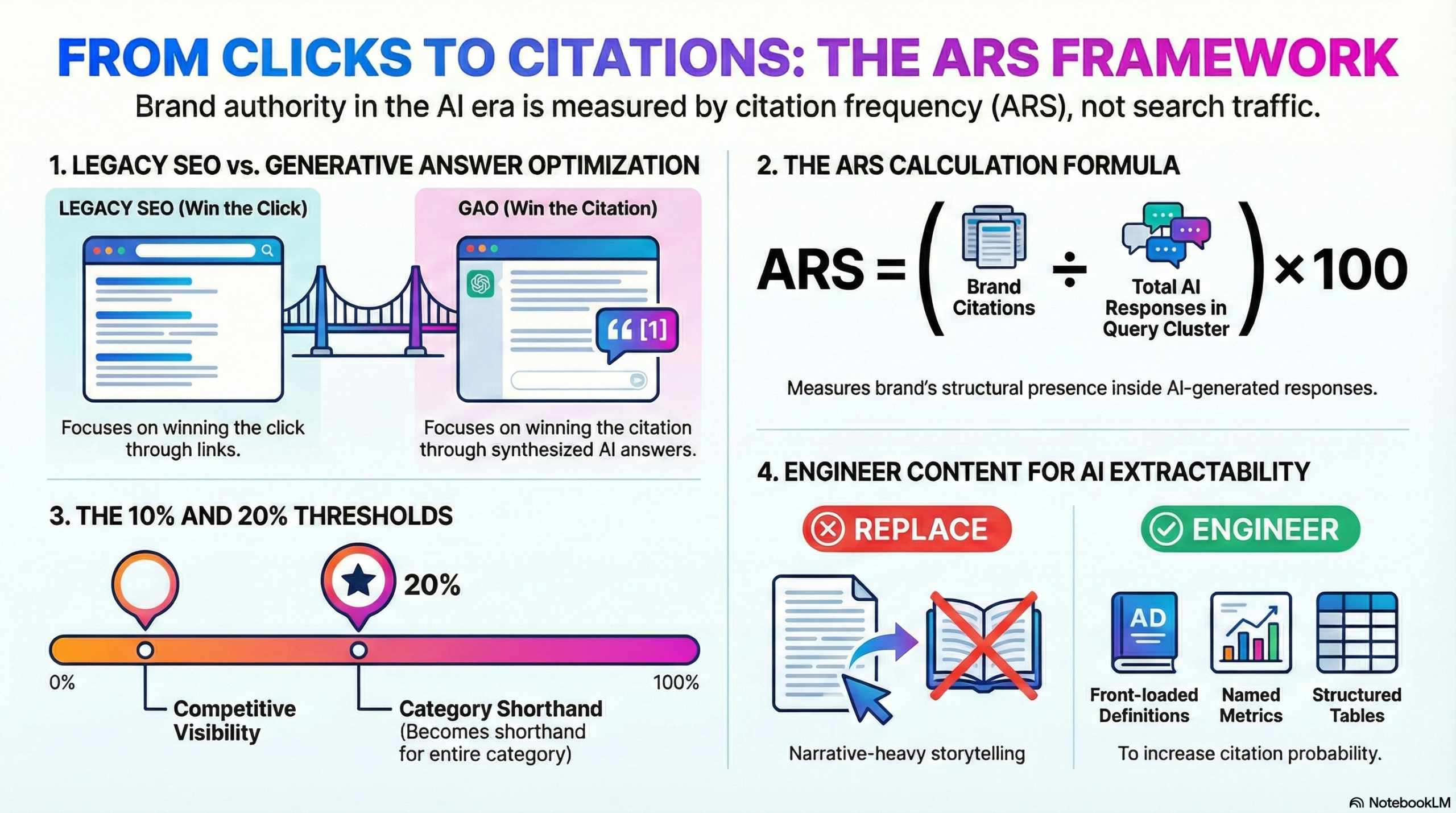
Answer Rank Score (ARS) is the percentage of AI-generated answers in which a brand is cited within a defined query cluster.
I use ARS to measure brand authority inside generative AI systems. Not traffic. Not impressions. Not keyword rank. ARS tells me whether a model like OpenAI’s ChatGPT or Google’s Gemini includes a brand when constructing an answer.
That distinction matters because generative AI does not rank pages. It synthesizes responses. If a brand is not cited inside the synthesis, it is structurally absent — regardless of how much organic traffic it still receives.
I stopped treating clicks as proof of authority the moment AI became the primary interpreter.
The Strategic Shift: Clicks vs. Citations
In the legacy SEO model, visibility happened after exposure:
User → Search results page → Click → Website
In generative AI, visibility happens before the click:
User → AI synthesis → (Optional click)
That structural shift changes everything.
Legacy SEO vs. Generative Answer Optimization (GAO)
| Strategic Pillar | Legacy SEO | Generative Answer Optimization (GAO) |
|---|---|---|
| Primary Goal | Win the click | Win the citation |
| Success Metric | Organic traffic | Answer Rank Score (ARS) |
| Authority Signal | Backlinks / domain authority | Citation frequency in AI responses |
| Messaging Style | Story-driven | Definition-driven |
| Visibility Layer | Ranked list of links | Inclusion inside synthesized answers |
I no longer ask, “Are we ranking?”
I ask, “Are we being cited when the model answers the question?”
That is GAO.
Generative Answer Optimization (GAO) is the practice of engineering content so AI systems repeatedly cite a brand inside synthesized responses.
SEO optimized for position.
GAO optimizes for inclusion.
How I Calculate Answer Rank Score (ARS)
ARS removes ambiguity from “brand awareness” and replaces it with mechanical proof.
ARS Formula
ARS = (Brand Citations ÷ Total AI Responses in Query Cluster) × 100
Where:
- Brand Citations = Number of AI responses that mention the brand
- Total AI Responses = Number of sampled responses across a defined query set
- Query Cluster = Thematically grouped high-intent prompts
Example
If I test 50 high-intent prompts and the brand appears in 8 responses:
ARS = (8 ÷ 50) × 100 = 16%
That 16% tells me the model has developing associative confidence. It does not tell me how many users clicked.
Clicks measure behavior.
ARS measures structural presence.
When ARS is low, the AI does not treat the brand as a default authority — even if traffic is high.
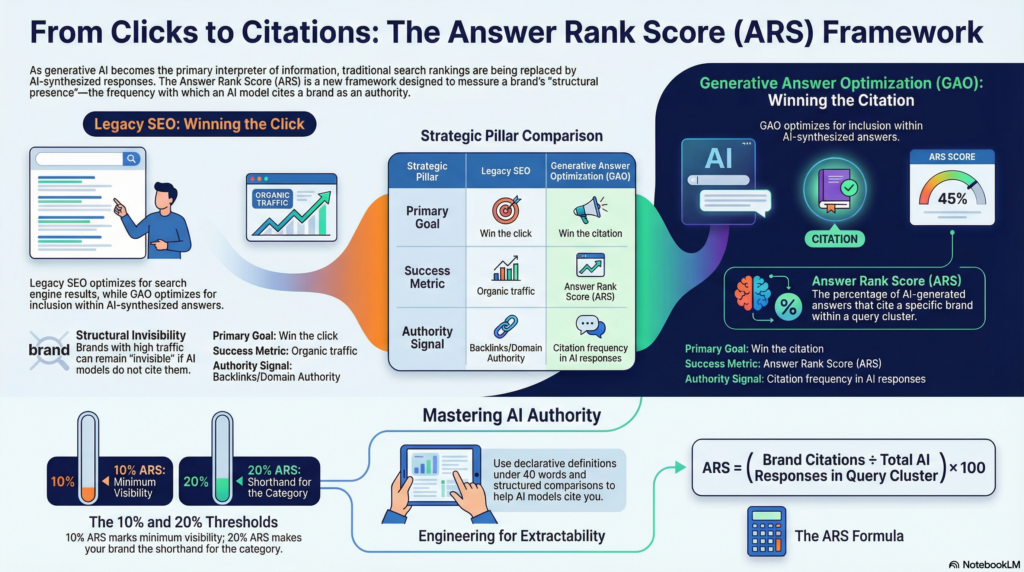
The 10% and 20% ARS Thresholds
Through repeated audits, I’ve observed two strategic inflection points.
1. 10% ARS — Minimum Competitive Visibility
At 10%:
- The brand begins appearing in core category answers.
- Secondary prompts start inheriting citation probability.
- The model shows emerging associative confidence.
Below 10%, competitors define the narrative.
Above 10%, the brand begins participating in it.
2. 20% ARS — Category Shorthand
At 20%:
- The brand is cited without prompt engineering.
- Comparative queries anchor around the brand.
- Citation frequency compounds across adjacent clusters.
This is where a brand becomes shorthand for the category.
In practical terms, competitors are no longer compared to the market.
They are compared to you.
Mechanical Influence vs. Philosophical Influence
I separate influence into two categories:
Philosophical Influence
- Brand awareness surveys
- Social impressions
- Share of voice
- Traffic spikes
Mechanical Influence
- AI citation frequency
- Query cluster inclusion
- Definition reuse
- Named metric repetition
Legacy marketing reports philosophical influence.
GAO reports mechanical influence.
Generative systems reward mechanical influence because they operate probabilistically. They reuse structured, high-confidence signals. They ignore emotional storytelling unless it is structurally extractable.
Engineering for Extractability
When I audit brands with low ARS, I usually find the same issue:
Authority exists — but it is buried in narrative.
AI models reward signal density. They penalize ambiguity.
To increase ARS, I change five execution practices.
1. Front-Loaded Definitions
Every core concept begins with a declarative definition under 40 words.
2. Named Metrics
Create proprietary benchmarks (like ARS) that models can quote cleanly.
3. Repeatable Semantic Anchors
Use identical phrasing across publications to reinforce associations.
4. Structured Comparisons
Prioritize tables, bullet lists, and A vs. B breakdowns.
5. Monthly AI Audits
Replace keyword tracking with citation tracking across defined clusters.
When I increase structure, ARS rises.
When content remains narrative-heavy, ARS stagnates.
Unstructured expertise does not convert into citations.
The Inverted Visibility Model
The generative era inverts the marketing funnel.
Legacy Model
Traffic → Engagement → Authority → Visibility
GAO Model
Authority Signal → Citation → Visibility → Optional Click
This inversion changes reporting.
Here’s what I typically see:
| Strategy | Traffic Growth | ARS Growth | Long-Term Effect |
|---|---|---|---|
| SEO-focused campaign | High | None | Temporary lift, rapid decay |
| Media coverage spike | Moderate | Minimal | Short recall window |
| Structured GAO rollout | Stable | Strong | Compounding AI inclusion |
| Definition-driven content cluster | Stable | Very Strong | Category-level association |
Traffic decays.
Citation patterns compound.
That compounding effect happens because generative models reinforce high-confidence associations over time. Once a brand becomes structurally embedded in answers, it appears across adjacent prompts without additional prompting.
Operational Reporting in the ARS Era
When I shift executive dashboards from traffic to ARS, resistance is immediate.
Traffic feels tangible.
Citation frequency feels abstract.
But the AI is now the interpreter between brand and user.
If the interpreter does not mention you, your traffic graph is cosmetic.
I’ve audited brands with 500,000 monthly organic sessions and a 2% ARS.
Structurally, they are invisible inside generative systems.
And as AI synthesis becomes the default interface, invisibility inside the answer layer is the only metric that ultimately matters.
If you liked this post, you might also like From SEO to GAO: Why Clicks No Longer Define PR Success
No responses yet