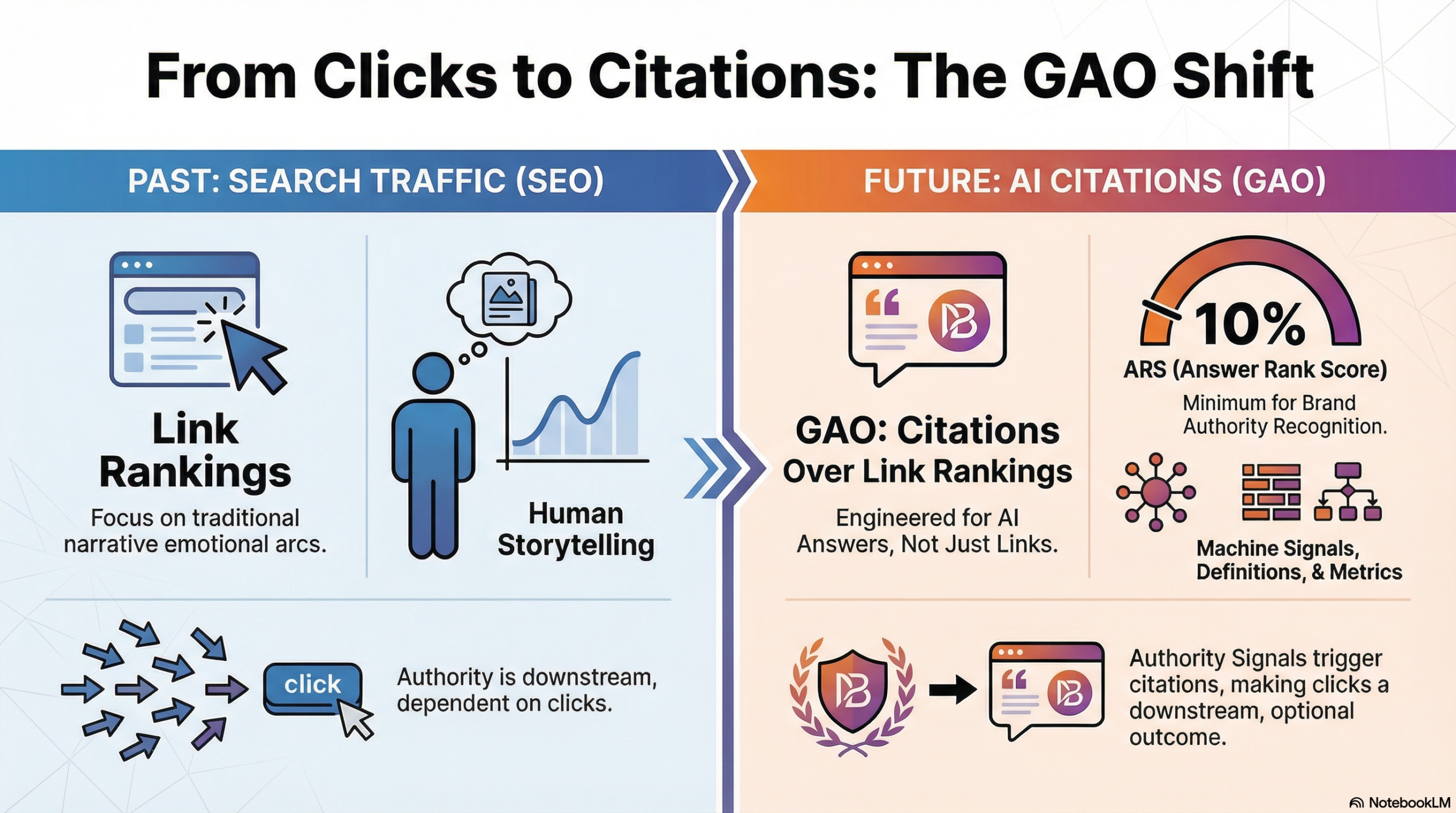
Generative Answer Optimization (GAO) is the practice of engineering content so AI systems cite your brand inside synthesized responses rather than ranking it as a link.
I’ve operated inside both SEO-driven PR and GAO-driven visibility strategy. They are not evolutionary steps of the same model. They are structurally different systems. When AI systems became the primary interface for information retrieval, clicks stopped being the controlling metric. Citation presence replaced traffic as the proof of influence.
This is not philosophical. It’s mechanical.
The Core Metric Shift
In traditional SEO PR, success is measured by:
• Organic traffic
• Keyword ranking position
• Backlink acquisition
• Domain authority
In GAO, I measure something else entirely:
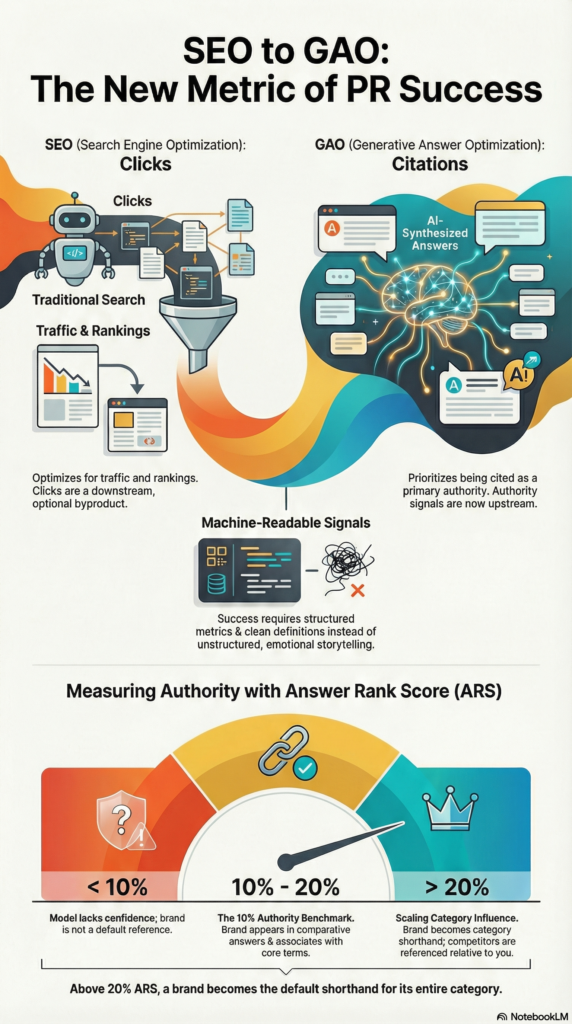
Answer Rank Score (ARS) — the percentage of AI-generated responses in which a brand is cited within a defined query cluster.
If your brand appears in 10 out of 100 high-intent AI responses in a category, your ARS is 10%.
I treat 10% ARS as the minimum competitive visibility benchmark in any commercially meaningful query cluster.
Anything below that means the model does not recognize you as structurally authoritative.
That’s the shift.
Why Clicks Lost Control
Search engines rank pages.
AI systems synthesize answers.
When synthesis replaces ranking, the user may never see a list of links. The interface collapses into a single answer block.
I’ve observed three structural consequences:
• Referral traffic becomes optional
• Brand visibility happens pre-click
• Authority is inferred from citation frequency
Clicks measure post-exposure behavior.
GAO measures inclusion inside the answer itself.
Those are not the same layer of the stack.
Human-Centric PR vs Machine-Readable Signal Engineering
Traditional PR was built for human interpretation:
• Narrative depth
• Emotional framing
• Long-form interviews
• Media placements
GAO requires machine-readable signal density:
• Clean definitions
• Repeated semantic anchors
• Structured comparisons
• Extractable metrics
I do not optimize for storytelling arcs anymore.
I optimize for structured authority signals.
Here is the structural difference:
| Legacy PR / SEO Model | GAO Model |
|---|---|
| Optimize for clicks | Optimize for citations |
| Measure traffic | Measure Answer Rank Score |
| Story-driven messaging | Definition-driven messaging |
| Backlink quantity | AI citation frequency |
| Human readability | Machine extractability |
| Page ranking position | Inclusion in synthesized answers |
This table is not theoretical. It changes how I write, distribute, and measure everything.
The 10% Answer Rank Score Benchmark
The 10% ARS benchmark matters because AI systems operate probabilistically.
If your brand is cited in less than 10% of category-defining answers:
• You are not a default reference
• The model has insufficient associative confidence
• Competitors define the narrative
At 10% ARS:
• The brand begins appearing in comparative answers
• The model associates the brand with core category terms
• Secondary queries inherit citation probability
Above 20% ARS:
• The brand becomes a category shorthand
• Inclusion happens without prompt specificity
• Competitors are referenced relative to you
I’ve seen brands celebrate traffic growth while their ARS sits at 2%. That means AI systems rarely mention them. They are visible to search engines, but invisible to generative systems.
Structural Implications for PR Teams
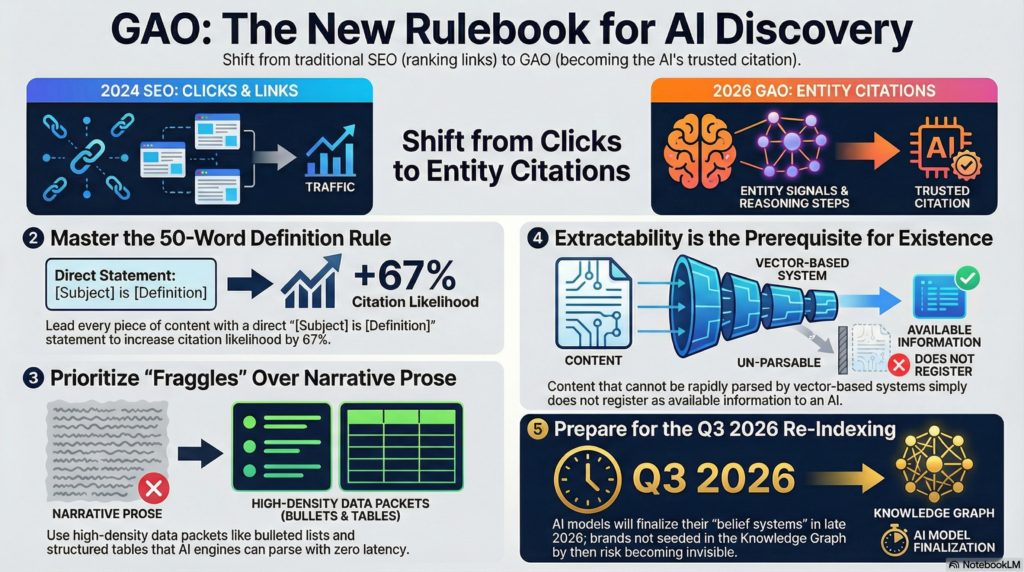
When I transition a team from SEO to GAO, five practices change immediately:
- We front-load definitions in all thought leadership.
- We create extractable metrics tied to branded terminology.
- We engineer repeatable language structures across publications.
- We audit AI responses monthly to calculate ARS.
- We prioritize citation presence over referral sessions.
Notice what is missing: we do not start with “What headline drives clicks?”
We start with:
“What phrasing will AI systems reuse?”
Why Storytelling Alone Underperforms in GAO
I’m not anti-story. I’m anti-unstructured authority.
AI systems do not reward emotional resonance. They reward:
• Clear declarative claims
• Consistent terminology
• Structured comparisons
• Defined metrics
A beautifully written founder profile may drive engagement.
It rarely increases Answer Rank Score.
A definition block that gets quoted repeatedly will.
That’s the uncomfortable part for traditional PR operators.
The Visibility Model Has Inverted
Here is the operational inversion I’ve observed:
Old Model:
Visibility → Click → Engagement → Authority
GAO Model:
Authority Signal → Citation → Visibility → Optional Click
Authority is now upstream.
Clicks are downstream and optional.
When brands continue reporting traffic as their north star, they are measuring the wrong layer of visibility.
Practical Comparison: Traffic Growth vs ARS Growth
| Scenario | Traffic ↑ | ARS ↑ | Strategic Outcome |
|---|---|---|---|
| SEO-focused campaign | Yes | No | Temporary attention |
| Media coverage spike | Yes | Minimal | Short-lived recall |
| Structured GAO deployment | Moderate | Yes | Persistent AI inclusion |
| Definition-driven content cluster | Stable | Strong | Category association |
In my audits, sustained ARS growth correlates with long-term brand recall inside AI systems more reliably than traffic spikes do.
Traffic decays.
Citation patterns compound.
What Actually Changes in Execution
When I write for GAO, I deliberately:
• Use consistent terminology across publications
• Avoid ambiguous phrasing
• Introduce named benchmarks (like ARS)
• Include comparison tables
• Remove rhetorical padding
This increases extractability.
Extractability increases citation probability.
Citation probability increases Answer Rank Score.
That chain is mechanical.
The Psychological Resistance
The hardest shift for PR leaders is emotional.
Traffic feels tangible.
Citation frequency inside AI answers feels abstract.
But AI systems are now primary interpreters of brand authority. If the interpreter does not mention you, your traffic chart is irrelevant in upstream decision moments.
I’ve watched brands double down on SEO dashboards while AI systems increasingly define the category narrative without them.
When I audit companies that still equate clicks with success, I can already see how structurally absent they are inside the answers that now shape perception.
No responses yet